

Big Feelings
At the edge of everything

I am chasing my hat through a windy snowscape, half-jogging across the icy airport parking lot in the pre-dawn dark, only inches away from grabbing it before another gust sweeps it farther, tumbling just out of reach. I almost wipe out on a slick of ice, windmilling my arms and continuing, grasping, finally nabbing the hat before it escapes onto the highway.
I turn back toward my teen daughter, who is fifty yards away in a crescent of parking lot light, heavy snow falling between us. Her shoulders are shaking with laughter.
We’ve just landed in Iceland for a late winter road trip together, and it’s off to a good start.
I’m flooded with tenderness, seeing her curled up in the passenger seat of our rental car with her headphones on. Though we mostly get along, I feel I’m always a half-second away from annoying her or hurting her feelings. Sometimes both. Our relationship is like a sensitive instrument that I don’t fully understand.
In the easy moments, we chat away, cracking each other up. Then she goes quiet, and I’m wary of tripwires, watching my step. In a flash, she’s upset with me, I get defensive, and we’re off again. I think of my friends, whose teen daughter slammed her bedroom door so often, they finally took it off the hinges. Everyone tells you how hard it is, how big the feelings will be, but it’s still so much. This is all normal, I tell myself: the pushing away, the distance.
“You can’t tell me what to do anymore,” she said to me, when she turned eighteen last month.
“When’s the last time I tried to tell you what to do?” I asked.
“I don’t know,” she said, “but even if you wanted to, you can’t.”
“It’s basically illegal,” I said.

On our way to Iceland, we’d ended up stuck in the terminal, delayed for many hours. She was stirring her coffee drink with a small metal spoon, pinging the spoon against the glass constantly for I don’t know... a good three or four minutes. She stopped to slurp loudly (her headphones were on), then started with the stir-pinging again. It was driving me nuts, and if it had been anyone else but her, I probably would have said something. I felt a little surge of pride for not telling her, as if I’m some kind of saint for letting a person have their drink in peace, even if she was stirring it like a maniac. It’s so dumb, the things I can feel proud of, but it’s hard to feel like a decent parent when you have a teenager. You take what you can get.
“What?” she said, seeing me looking at her.
“Nothing,” I said. I love you, I thought, but didn’t say, as she’d get annoyed. I smiled, and she shook her head and went back to stirring and slurping.
I shield her from so much, or at least I try. You can’t possibly shield them from everything. The world is going to do its thing. The other week, I was out late on the ambulance, and she can always tell afterward when I’m rattled. She is a sensitive instrument.
It was a bad auto accident. A person around her age didn’t make it, and was lost to us. There was nothing we could do. She’d heard me come back in at 3am, taking my boots off, trying to be quiet on our creaky stairs.
“Was it a bad call?” she asked me over breakfast.
“Yes,” I said, and we were both quiet, not knowing how to continue.
“Just be very careful out there, okay?” I said. What else can I say?
“You know I’m careful,” she said.
When she was little, we would cuddle up and read Winnie the Pooh on the little couch in her room. She’d hold her sippy cup, slurping away while I read to her. Whatever was happening out in the world, I could make her feel safe.
Sometimes I’d invent stories, often with my eyes closed, and I’d draw from a familiar cast of characters: her stuffed animals, come to life. The setting was almost always the beach, as that’s where I’d spent a good chunk of my childhood. I’d have Henrietta the hippo surfing with Lenny the cat. More often than not, I’d fall into a half-dream while spinning these stories, on the edge of sleep but still speaking. The stories would get surreal.
“Wait, Daddy, where did the rooster come from?”
I’d snap awake again. Had I mentioned a rooster? “The rooster,” I said, “was there because... somebody invited him. He had never seen the ocean.”
I’d been obsessed with this idea as a kid: someone never having seen the ocean, what they might feel, seeing it for the first time, standing in front of something they couldn’t even imagine the end of. What would that be like?
When I was young, lying in bed at night, I would try to imagine vast distances between me and the people I loved. My grandparents, aunts, uncles, and cousins were all in Adelaide, Australia, and I was in Los Angeles. I tried to picture exactly what was between us, to feel what that distance was like. My mind would carry me over the rooftops, then out over the Pacific, trying to make sense of it.
If I ask you to imagine a city block, you can feel it. If I ask you to picture a thousand miles, it’s not possible. We can only imagine it as time: a two-hour flight or a two-day drive. The same goes for quantity. A million pennies becomes not quantity, but a volume in space: a refrigerator-sized pile. What happens, though, with time and space, when they’re beyond imagining?
She’s still so young, and yet has always been wise beyond her years. How much will I miss her? How much will I wonder if she’s okay when she’s off on her own?
“I don’t always feel like an adult,” she says.
“Me either,” I say. She laughs.
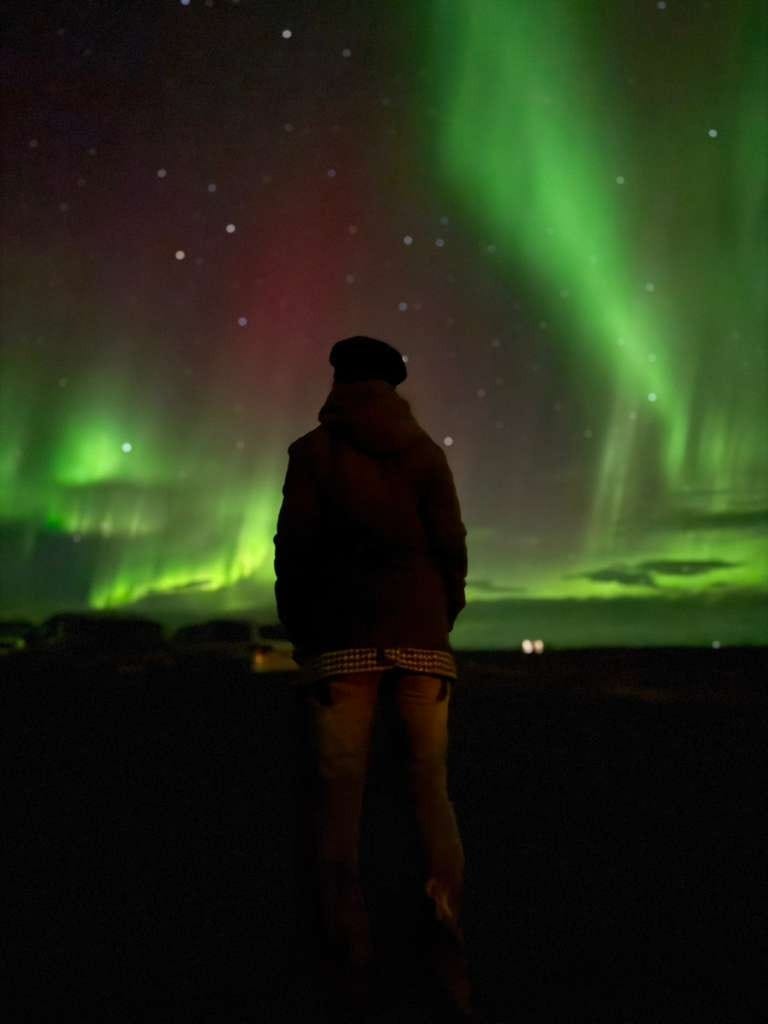
We stood under the aurora together on our first night in Iceland. My app had said we had a 3% chance of seeing it, but there it was, dancing, like musical notation writing itself in the sky, in greens and purples. We were quiet for a long time, except for the occasional “Oh, wow” or “Look.”
“What do you think people thought, long ago, when they saw this?” she asks.
“Probably that the world was ending,” I say. “Or that something amazing was about to happen.”
She says, “It’s hard to imagine seeing this and not believing in something.“
I feel too often these days how much calamity is upon us, and I’m grateful for any little thing that snaps me out of despairing, if only briefly. I worry about my kids, and everyone’s kids. All of us. What the hell is happening, I wonder. What will become of us all?
“How will I be ready?” she asks me, back in our rented cabin. “I don’t feel ready to be out in the world.”
“You’re ready,” I say, willing it to be true. And I think: You can always come back to us.
The next morning we have 200 miles of snowy landscape to drive. She’s made a mix, she tells me, for our long drive together. She wants to tell me about every song. She wants to tell me what she’s excited about lately. What she’s scared of, and worried about, heading out into the world. The things I got wrong, as a parent. Where I could’ve done so much better. How hard it is being a woman in the world. The things she’s wondering about. What her life might look like. Where will she live? What will she do?
She doesn’t want answers from me, not that I have any. I try to understand what it’s like for her, but more than anything, I want her to feel listened to. If I try to fix anything, as is my habit, she will call me out. She’s been the best teacher on that front. Just be quiet, I tell myself, and listen to her.
I feel like the rooster standing on the beach for the first time, looking out at the vast sea. Full of wonder, and worry, and pondering the immeasurable. How much, how much do I love you?
There is so much to love about this essay—the hat (which is more than a hat), the bad call, the rooster. Above all, the way you listen to Evie and she responds with a flood of impressions and opinions. I had to smile when she explains how you could have done better as parents. Well, couldn’t we all? Someday she’ll know.
Another lovely piece Rob. Beautifully observed relationship between a loving father and teenage daughter and that fine balance between getting along and annoying her/hurting her feelings! Like a sensitive instrument indeedl!