

After The Beep
Coming to you live, from the past

When my son was younger, he asked me, “Was everything black and white when you were a kid?” I asked if he meant movies and TV, assuring him we had color, but no, he said, “I mean the world.”
It’s a fair assumption. I like imagining that life before I was born in 1971 was actually black and white, just like everything in the 80’s was a little fuzzy, and the 90’s a bit pixelated. It does feel that way, seeing everything on replay.
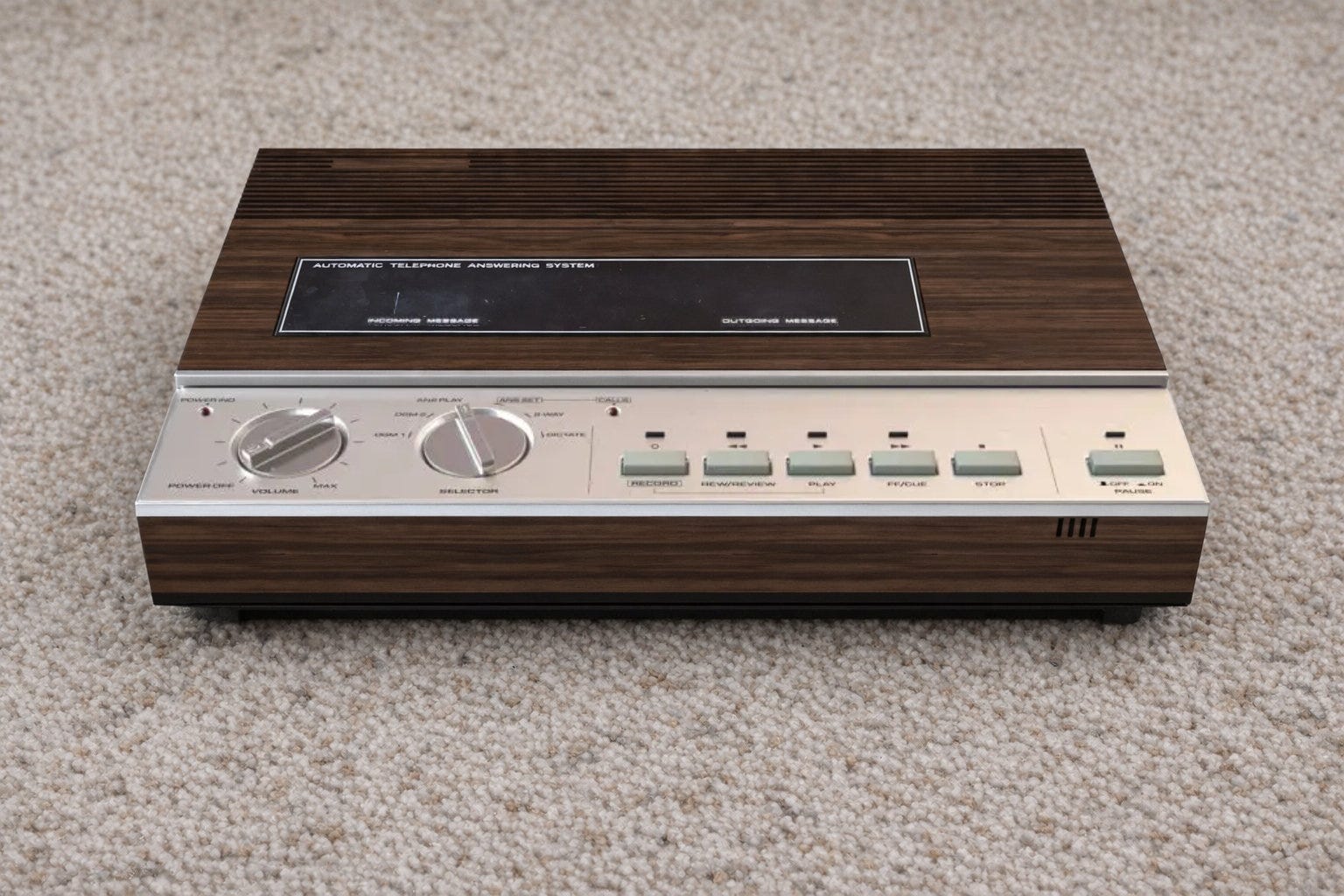
I tell my kids that before mobile phones and voicemail, we had huge, clunky answering machines. My dad was always an early adopter, so he got one of the very first consumer models, in 1980 or so. It had faux wood panelling and two cassette tapes in it, and came with something that looked like a giant garage door clicker so you could call it from outside the house. He kept the answering machine on the carpet next to his nightstand, wires everywhere, one of those temporary conditions that becomes permanent.
Watching TV in the next room, I overheard my dad recording his very first outgoing message. He was reading from a script he’d written out for himself, based on the suggested script in the manual. He kept screwing up and starting over, which in those days meant rewinding the tape, clicking a button, then waiting five seconds or so for the beep. He must’ve done this a dozen times, each new attempt sounding increasingly unhinged.
I knew the script by heart after hearing it so many times. It ended with: “Don’t forget, wait for the beep-tone!” By the twentieth try, he’d adopted a deranged sing-song voice. He was tripping over his words. “Don’t forget to... for the… DAMMIT!” He rewound and started over, plonking the buttons so hard I thought he’d break the machine.
He might’ve been going off-script with the word “beep-tone.” He had a lot of words that were unique to him. He often just winged it with pronunciations, and he butchered everyone’s names. Most of the time, though, he just called everything a “deal.”
About my retainer: “Are you wearing your deal?!”
The TV remote: “Gimme that deal…”
The garage door clicker: “Don’t touch the deal.”
Sometimes it was unclear, like: “Frank bought one of those deals, you know, with the buttons?” Was this an electric razor, or maybe a cardigan? It was hard to tell all the deals apart.
His new answering machine, of course, was a deal. We’d come home, and he’d tell me, “Go check the deal.”
I remember sprinting into his bedroom to see if the red light was blinking. I flat-out dread anyone leaving me a voicemail today, but back then, this was the most exciting thing in the world. Somebody has left us a message! I’d see that red light blinking, and it felt like anything was possible. Who knows who might have called?
I’d press Play, and here was someone from my dad’s work, a gruff voice babbling in business-speak. What on earth were these people saying to each other? They all sounded annoyed about everything all the time. Next message.
Some unnamed person, uncertain. “Hello? Hellooooo?” then a sigh, and a loud click. Beep. End of messages. I ran back to the kitchen.
“Well, who was it?” my dad asked. I was already rummaging in the cupboard for a snack.
“I don’t know,” I said over my shoulder. “Nothing good.”
Back in those days, he’d pick us up after school every other Friday for his weekends, and we’d go to a bar on San Vicente called Bergen’s for happy hour. My sister and I were 8 and 10, respectively. We’d stay there an hour or two.
“Everyone’s so friendly here,” I told my sister. A woman with massive, teased red hair came up to us, “Well aren’t you two just adorable!” She smelled amazing. She booped my nose, and offered us a little plastic bowl of peanuts. My sister and I spun on barstools and threw peanuts at each other’s open mouths. We crawled around on the sticky floor looking for dropped change. We’d ask strangers for quarters for the tabletop version of Centipede in the corner, and people would just hand them over, shooing us away. I loved this place.
Off to one side was an antique-style red phone booth that was soundproof and had a column of red buttons inside that played background sounds. It was for making calls while pretending you weren’t in a bar. You could press a button and make it sound like you were calling from a busy highway, or better yet, a farm, with bleating goats and a rooster. With another button press, you were at the beach, with seagulls squawking. You could be anywhere.
It cost money to make a call, but not to play the sounds. My sister and I would press these buttons and come up with stories about what happened. “I’m going to be late. That’s right, I crashed my car near this farm. Yes, those are chickens! It’s a real mess!”

There are four voicemails I keep on my phone, all from my dad, who is now exactly three years gone. I stand and listen to them at our kitchen island, these messages from the past.
“Hi Rob,” he says. “Just trying to catch you, but I guess you’re busy. Hope you have a great day!”
I also have a couple screenshots of text threads. Once, he was texting me Palm Springs tram, over and over. I responded, Hi Dad, it’s me! Are you trying to do something with the tram?
Tram tickets, he texted back. Palm springs tram.
Dad! It’s me, Rob! Love you!
Rob? he texted back. I’m trying to reach the tram.
I open this screenshot sometimes when I miss him. It’s in a folder called “funny” on my laptop, and it invariably does the trick, though it makes me feel the loss, too.
These voicemails, these texts, they mean something to me, even though they’re just bundles of 0s and 1s, little clusters of electrons. Like my dad, and me, and everything else, they’re brief constellations, everything eventually unraveling. Patterns recognizing patterns. The where and when of it all doesn’t work remotely how we imagine. At the very least, it’s an open question.
I hadn’t really seen, when we got the first answering machine, that it was a form of time travel. A ripple on a pond, reverberating. How memories are like this, too. Ever wobbly, and maybe fading a bit in strength, but still going, running through me.
My sisters and I do this often, like we’re rewinding the tape, over and over. Remember when Dad tried to leave the house with his sweatshirt tucked into his jeans? This is a family favorite. My sister Nicole said, “Dad! You can’t come to my soccer game like that! Everyone will think you’re a dork.” His shrugged response: “Maybe I think they’re a dork.”
Sometimes these memories come to me unbidden. Like pushing a red button in the booth, there are squawking seagulls, a beach scene. There’s my dad standing in thigh-deep seawater behind his small catamaran sailboat, a beige canvas stretched across two orange pontoons. The halyard is flapping with a constant metal ping against the mast. I’m on the canvas, watching nervously as my dad pushes us out from shore. I’m still frightened, after the time we got turned by a big wave, then flipped in the surf, the mast snapping. I fell clear of the boat that time, tumbling in the whitewash, my hip scraping along the rocky ocean floor.
Now I worry: What if he doesn’t make it onto the boat in time? I’ll be left alone and won’t know what to do. With one great shove, we’re free from the wet sand, and he hops onto the back clumsily, with his gangly legs and red swim trunks, the canvas bouncing me a little when he lands on it. We’re heading into big surf, my stomach dropping as we crest a large wave, then land hard, aimed toward the unsteady horizon.
Beyond the break, I look back at the swells moving toward the beach, watching them curl and crash behind us harmlessly. The shore’s disappearing fast, the sail snapping into its fullness. My dad and I are in motion together, part of something I don’t have words for. Some kind of unknowable deal, maybe. We sail into this vast nothingness, the afternoon sun low in the cloudless sky.
“Okay,” he says, “okay!” I trail my hand in the warm green-black water next to the pontoon, resting a sandy, sunburned cheek against the canvas. The wind whips louder now, the boat cutting through the water like it knows where it’s going. Into this scene, my dad calls out, sounding far away to me then, and now, as I hear it across space and time, like it’s arriving through static.
“Here we go!” he says.
Beautifully conjures the bitter sweet memories from childhood of parents we miss. Brought tears to my eyes. Thank you.
Well, I'm now deep in all of my 'feels' this morning. Thank you for the wonderful simple memory. Sometimes they are the absolute best.